The Thirty-Second Welcome: Reading a Restaurant Before You Sit Down
You push a door and something has already happened. Someone looked up, or didn't. Someone said hello, or half-said it while walking away. You were told a time, or given a shrug dressed up as a smile. None of it appears on the menu, and yet it shapes the next ninety minutes more reliably than the décor, the wine list or the pedigree of the chef.
The arrival is the least-designed part of a restaurant. Menus get rewritten, lighting gets fiddled with, someone agonises over the font on the bill. But the welcome is improvised, on the night, by whoever happens to be nearest the door — and repeated a hundred times in a week. That's exactly why it's worth watching. Anything that gets done that often, that quickly, stops being performance and starts being culture.
Why the first thirty seconds tell you so much
A restaurant can buy a beautiful room. It can't buy the reflexes of the person at the door. What you're reading in that half-minute is a set of habits: whether the team notices people, whether they tell the truth under pressure, and whether they have a plan for the awkward customer who turns up at 7:40pm on a Friday with no booking and a pushchair.
There's also a simple asymmetry at play. A kitchen can hide a bad night behind a good plate. Front-of-house at the door has nowhere to hide — either someone clocked you or they didn't.
What a good welcome actually looks like
Ignore the theatrical version. The best arrivals are almost boring, and they tend to do three things in order.
First, they see you. Eye contact inside a few seconds, even if the person is mid-task. Second, they tell you something true — an honest wait, a real answer about whether the kitchen can fit you in, a straight 'give us ten minutes and we'll sort it'. Third, they place you. Somewhere specific, out of the draught, with a sense that a decision has been made rather than a guess.
Notice that none of that requires a lectern, a reservation system or a script. A café in a Yorkshire market town with a chalked 'sit anywhere, love' can pass this test perfectly. A polished chain with a chipper greeting can fail it the moment something goes slightly wrong.
The small signs worth clocking
- The pause before 'have you booked?' Not a red flag in itself. What matters is what comes after: a useful plan, or a slow look at a screen and a vague apology.
- The over-apology. 'We're absolutely slammed, it's chaos' is honest, and honesty is worth something. But if the greeting is delivered as a warning rather than a welcome, believe it.
- The clipboard that never looks up. Being processed is different from being greeted, and you can feel the difference instantly.
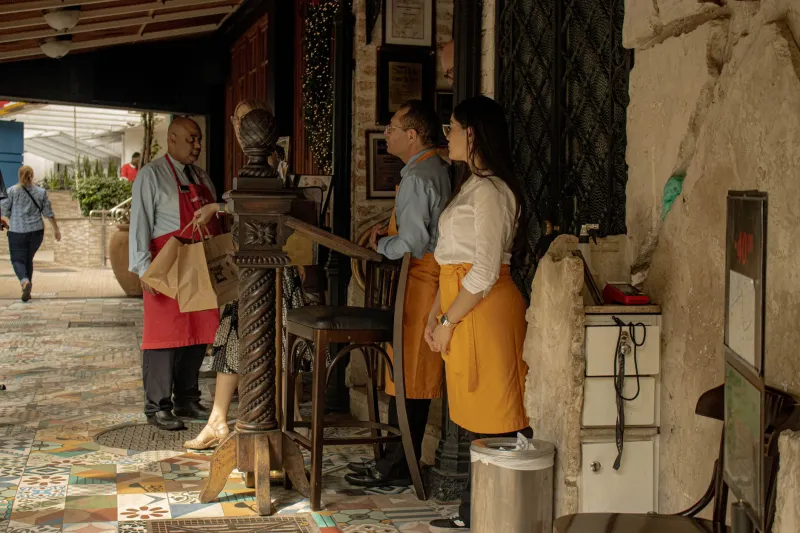
- The escort. Does someone walk you to the table, or point across the room? Both can be fine in the right room. Only one of them feels like hospitality.
- The question order. Greeting first, then 'how many?' — or 'how many?' first and a greeting if there's time?
- The awkward arrival. Coats, bags, buggies, dogs, a wet umbrella. How the door copes with the inconvenient bits of a human being is a fair proxy for how the kitchen copes with a complicated order.
Red herrings, so you don't misread the room
Busyness is not rudeness. A queue out of the door at 1pm on a Saturday is usually a good sign, not a bad one. A tiny place with one person on the floor cannot be at the door and at the pass simultaneously — judge how they recover, not how quickly they got to you. And a slow welcome in a half-empty restaurant is a very different signal from a slow welcome in a full one, because only one of them has an excuse.
Equally, don't be seduced by fluency. The smoothest greeting in Britain can come from a place that has rehearsed warmth and forgotten the rest. The tell comes when the plan has to change — a table isn't ready, a dish has run out, the card machine is playing up. Watch who takes charge.
A diner's guide to reading it without becoming a fussy customer
Give it a sensible clock. Roughly ten seconds for someone to acknowledge you, half a minute for a proper word, a couple of minutes for a plan. Not a stopwatch — a feel.
Ask one clear question early. 'Have you got a table for two, or shall we come back?' The shape of the answer tells you more than its content.
Watch the handover. If the person at the door passes a detail to the next person — table four, one doesn't eat fish, birthday — you're in decent hands.
Look at the people behind you. If the couple in walking boots get the same welcome as the table in suits, you're looking at culture rather than a performance.
Do your half. Book when you can, step out of the doorway, say how many and how long you've got. A fair share of bad first impressions are earned by us, not them.
When to walk, and when to wait
Walk away if ninety seconds pass with no eye contact, no words and no obvious chaos to explain it — or if the greeting treats your arrival as a problem to be managed before you've even taken your coat off. Meals rarely recover from a door that didn't want you.
Stay if you've been given a real time, somewhere to wait and something to drink while you stand there. That's a restaurant that has decided it wants you in the room. Everything after that is a conversation between your table and the kitchen — but the door got the first word in, and it's usually right.