Chicken Nuggets Are Not a Childhood Requirement: Family Dining Deserves Better in 2026
Photo: Internet Archive Book Images, No restrictions, via Wikimedia Commons
There is a moment in family dining when the adult menu arrives and the children’s menu arrives, and the gap between the two tells you everything. On one side: seasonal vegetables, local cheese, a proper sauce. On the other: nuggets, chips, a cartoon tomato and a promise that no flavour will be too much trouble.
This is not a new problem, but in 2026 it is harder to ignore. Restaurants that talk proudly about honest food, short supply chains and no-fuss cooking still hand children a laminated card that looks like it was designed by a focus group in 1998. The kids’ menu is broken. Not everywhere, and not always, but often enough that parents have learned to expect it.
The beige default
The standard children’s menu is a masterpiece of reassurance. It offers chips, breaded things, pasta with a sauce that tastes mostly of orange, and maybe a small bowl of peas as a nod to nutrition. It is cheap to produce, easy to freeze and almost guaranteed not to cause a scene.
There is nothing wrong with chips. A good chip is a fine thing. The problem is the default. When children are offered the same beige shorthand everywhere, they learn that eating out is a separate category from eating well. Adults get the real menu. Children get a safety blanket.
That is a strange message for a restaurant to send. If the food is good enough for grown-ups, why is it not good enough in a smaller portion?
Why it persists
Some of it is cost. A kitchen can buy frozen nuggets by the box and keep them forever. Some of it is risk: children can be unpredictable, and a restaurant would rather serve something bland than face a complaint. Some of it is habit. Parents order from the kids’ menu because it is there, and restaurants keep printing it because parents order from it.
But there is also a quieter issue. Family dining is often treated as a separate business from proper cooking. The adult menu gets the attention; the children’s menu gets the freezer. That is not honest food. It is convenience dressed up as care.
What good looks like
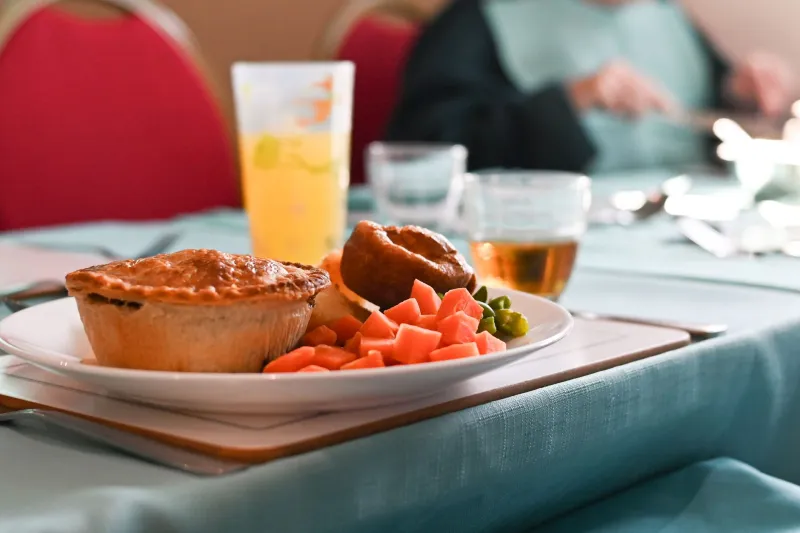
A good family restaurant does not need to reinvent the wheel. It needs to offer a smaller version of the real thing, or a simple dish made with the same care as everything else. A small roast dinner with proper gravy. A bowl of soup with bread. Plain pasta with butter and cheese, made in the kitchen rather than emptied from a pouch. A piece of fish with peas. A baked potato with cheese and salad. These are not fancy dishes. They are just food.
The best version is when children can order from the adult menu in smaller portions. Some places do this already, often without making a fuss about it. You ask for a half portion of the roast, or a small plate of the pasta, and the kitchen says yes. That single flexibility says more about a restaurant’s values than any statement on the website.
A practical checklist for parents
- Is there a children’s menu online, or only a vague promise of one?
- Does it offer smaller portions of the adult menu?
- Are there simple dishes made on site, rather than bought-in shapes?
- Is there a proper vegetable option that is not just peas?
- Are allergens and ingredients clear without a lengthy interrogation?
- Is there a time when families are genuinely welcome, rather than merely tolerated?
Questions to ask before you book
A quick phone call or email can save a lot of disappointment. Ask whether the kitchen does half portions of adult dishes. Ask whether the children’s menu changes with the seasons. Ask if the soup is made in-house and whether there is a plain version without too much spice. Ask about nuts and other allergens, and ask whether the chips are cooked in the same fryer as fish.
These are not difficult questions. A good restaurant will answer them without defensiveness. A great one will already have the answers on its website. If the response is a sigh and a recital of the nuggets-and-chips options, you have learned something useful.
The honest-food test
The test is simple: would you be happy to eat the children’s menu yourself? If the answer is no, why is it being served to people who are still learning what food can be? Children do not need blandness. They need familiarity, yes, but also variety, texture and the chance to try something that has not been shaped into a star.
None of this means every family meal has to be a lecture on seasonal produce. Sometimes nuggets and chips are exactly what the afternoon requires. But they should be a choice, not the only option. In 2026, with so many UK restaurants doing honest food well, there is no good reason for the children’s menu to remain the beige exception.