Crisp Skin, No Theatre: What a Café Jacket Potato Really Tells You
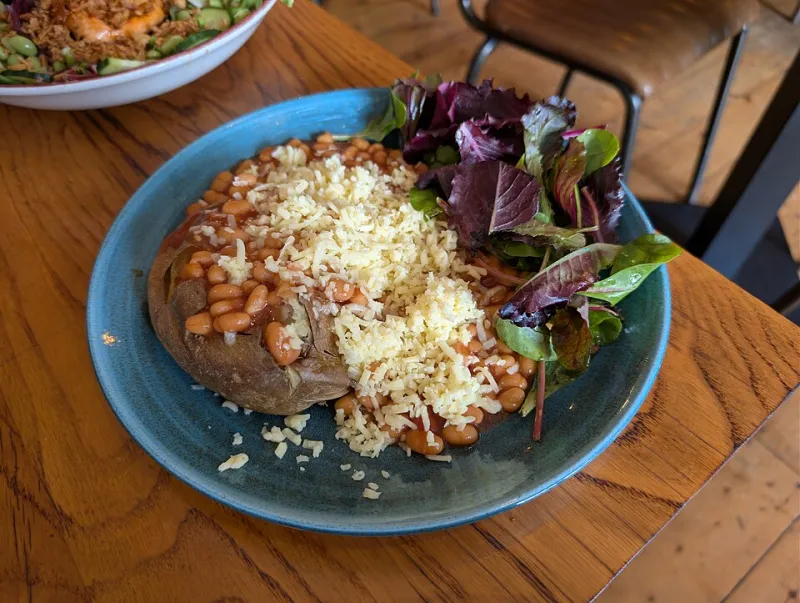
Photo: Andy Li, CC0, via Wikimedia Commons
A jacket potato is not a dish that shouts for attention. It sits near the bottom of a laminated menu, usually between the all-day breakfast and the tuna baguette, and it asks for nothing more than a fork and a bit of patience. That is exactly why it is worth ordering. In 2026, when so many kitchens are busy telling you how clever they are, the humble spud remains one of the honest tests of a café. There is nowhere to hide behind foam, garnish or a swoosh of something smoked. It is a potato, some butter and a filling. Either the kitchen has done the simple thing properly, or it has not.
The lunch that leaves nowhere to hide
A jacket potato is a timing dish before it is anything else. The skin has to be dry enough to crackle, the flesh has to be fluffy rather than dense, and the whole thing has to arrive hot enough that the butter disappears into it. Get those three things right and you can put almost anything on top. Get them wrong and no amount of cheese can rescue it.
That is why the jacket potato is such a sharp signal. A kitchen that can bake a potato properly is a kitchen that understands waiting. It knows that a spud cannot be rushed in a microwave and then flashed in an oven to pretend it has had a long, slow bake. It knows that holding potatoes in a hot cupboard for hours turns the flesh tight and the skin leathery. It knows that the difference between a good lunch and a bad one is often twenty minutes of doing very little.
Timing you can taste
You can read a lot from the first cut. A proper jacket potato opens with a little resistance and then gives way to a cloud of steam. The skin should be crisp at the edges, not wet, not oiled into submission, not so hard that you need a steak knife. The inside should be pale and loose, with enough structure to hold a filling but not so much that it sits on the plate like mashed potato that has given up.
If the skin is soggy, the potato has almost certainly been wrapped or stored badly. If the flesh is waxy and solid, it was the wrong variety or it was not baked for long enough. If the whole thing is lukewarm, the kitchen is not treating lunch as a service worth getting right. None of these are grand failures. They are small ones. But lunch is made of small things.
Butter is not a garnish
A good café does not treat butter as an afterthought. It offers it, properly, at room temperature, and it does not make you feel as though you have asked for something unreasonable. Butter should melt into the flesh, not sit in a cold yellow lump on top. It should be salted enough to season the potato from the inside. And it should be generous, because a dry jacket potato is one of the bleakest things on a British high street.
This is where restraint comes in. A kitchen that knows what it is doing does not need to drown the potato in butter or oil. It uses enough to make the thing taste like itself. The same goes for fillings. A cheese and bean jacket potato should taste of cheese and beans, not of a tin of beans that has been heated until it is sweet and watery. The cheese should be grated, not hacked into cold chunks. The beans should be hot but not volcanic. The whole thing should hold together on the plate.
The fillings that tell the truth
Cheese and beans is the classic for a reason. It is cheap, comforting and almost impossible to make glamorous. That is the point. If a café can make a good cheese and bean jacket potato, it is probably paying attention to the rest of the menu too.
Tuna mayo is the other great test. Good tuna mayo is seasoned, not sloppy, and made with enough care that it does not taste of cold mayonnaise and nothing else. A little spring onion or black pepper is fine. A bucket of sweetcorn is not. Coleslaw should be a side, not a flood. Salad garnish should be fresh or left off entirely. There is no shame in a plain jacket potato with a knob of butter and a pinch of salt, but there is shame in a plate that has been assembled with no thought at all.
Sourcing, price and the quiet details
The best jacket potatoes start with the right potato. Floury varieties — Maris Piper, King Edward, Rooster — bake into the fluffy interior that makes the whole thing worth eating. A café that names its potatoes, or at least says they are British, is usually a café that has thought about it. A café that serves a pale, waxy specimen with a filling that tastes of nothing is not necessarily malicious. It is just not paying attention.
Price matters too. In 2026, a proper jacket potato lunch should feel like good value. Somewhere between £6 and £9 is reasonable for a well-made spud with a sensible filling and a bit of salad. If it costs £12 and arrives with a tiny garnish and a lot of attitude, you are paying for the room, not the lunch. That is fine if the room is lovely. It is not fine if the potato is bad.
Signs to look for
A few practical things to check before you order. Does the menu say the potatoes are baked fresh? Is the skin dry and crisp rather than shiny? Does the server ask whether you want butter? Are the fillings named simply, without a paragraph of description? Is the cheese grated? Are the beans hot rather than tepid? Does the plate look like someone cared, even a little? These are not fancy criteria. They are the basics. But the basics are where most cafés either show their hand or quietly drop it.
Three unfussy spots to try in 2026
You do not need a guidebook for this. Look for the old-fashioned lunch counters, the market cafés and the places that have been doing the same thing for years. The Baked Potato Shop in Edinburgh is a good example of a spot that has built its reputation on the humble spud rather than chasing trends. The market cafés around Leeds Kirkgate Market are another: plain tables, proper portions, no fuss. And the lunch counters in Sheffield’s Moor Market are worth seeking out for the same reason. They are not destinations in the glossy sense. They are just good places to eat a potato.
The last bite
A jacket potato will not win any awards for innovation. It will not impress anyone on Instagram. But it will tell you whether a kitchen can bake, season, time and hold back. That is a lot to ask of a lunch that costs less than a round of drinks. In 2026, with so much noise on menus, the quiet spud is still one of the sharpest things you can order. If the skin crackles and the butter melts, you are in good hands. If it arrives wet and sad, you have learned something useful. Either way, you have had lunch. That is not nothing.